Spreadsheets remain one of the most widely used productivity tools in the world—powering everything from budgets and forecasts to lightweight databases and ad-hoc analytics.
Below is a data-driven snapshot of how spreadsheets are used today, where they’re most entrenched, and what trends are reshaping spreadsheet-heavy work.
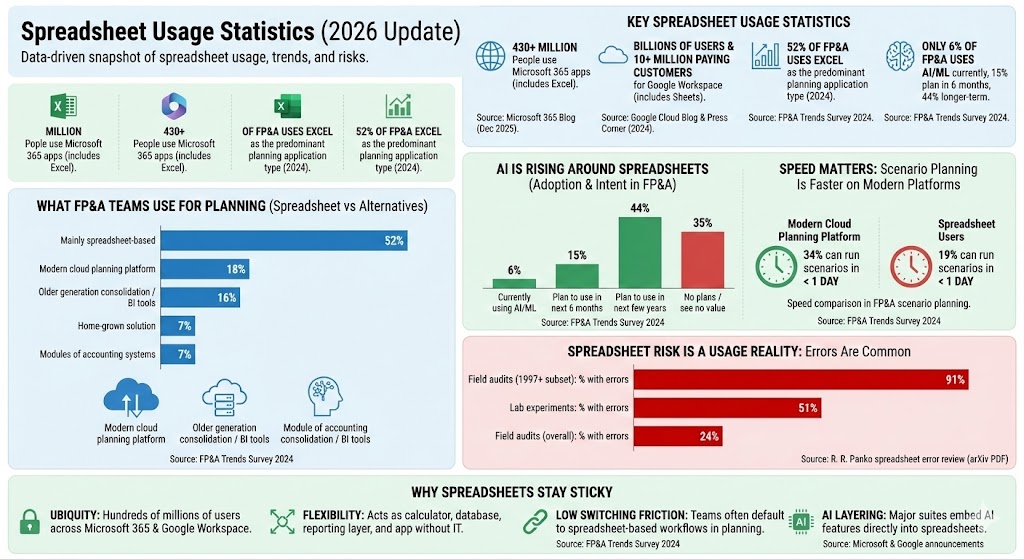
430+ million people use Microsoft 365 apps, which include Excel. Source: Microsoft 365 Blog (Dec 4, 2025).
Google Workspace has billions of users and 10+ million paying customers (Workspace includes Google Sheets). Source: Google Cloud Blog (Next ’24 post, Apr 9, 2024) and Google Cloud Press Corner (Nov 25, 2024).
In FP&A (Financial Planning & Analysis), Excel is the predominant planning application type (52%) in 2024. Source: FP&A Trends Survey 2024 (PDF).
In the same FP&A sample, modern cloud planning platforms are the next most used planning tool type (18%). Source: FP&A Trends Survey 2024 (PDF).
Older-generation consolidation/BI tools are used by 16% as the main planning application type (2024). Source: FP&A Trends Survey 2024 (PDF).
Home-grown solutions and modules of accounting systems are each used by 7% as the main planning application type (2024). Source: FP&A Trends Survey 2024 (PDF).
Only 6% of organizations in the FP&A sample are currently using AI/ML in 2024; 15% plan adoption in the next 6 months, and 44% plan adoption longer-term. Source: FP&A Trends Survey 2024 (PDF).
35% of organizations report no plans / see no value for AI/ML in FP&A (2024). Source: FP&A Trends Survey 2024 (PDF).
FP&A teams spend 35% of time on insights/actions vs 45% on data collection & validation. Source: FP&A Trends Survey 2024 (PDF).
In scenario planning, 34% of modern cloud planning platform users can run scenarios in less than one day vs 19% for spreadsheet users. Source: FP&A Trends Survey 2024 (PDF).
What FP&A Teams Use for Planning (Spreadsheet vs Alternatives)
The FP&A Trends Survey provides a clear view of where spreadsheets sit in planning workflows: spreadsheets (primarily Excel) remain the #1 planning tool type, while cloud planning tools are the most common alternative. Source: FP&A Trends Survey 2024 (PDF).
Label
Bar
Value
Mainly spreadsheet-based
52%
Modern cloud planning platform
18%
Older generation consolidation / BI tools
16%
Home-grown solution
7%
Modules of accounting systems
7%
Max = 52%. Widths: Mainly spreadsheet-based 100.00%, Modern cloud planning platform 34.62%, Older generation consolidation / BI tools 30.77%, Home-grown solution 13.46%, Modules of accounting systems 13.46%.
AI Is Rising Around Spreadsheets, But Adoption Is Still Early
Even in FP&A (one of the most spreadsheet-intensive functions), AI/ML adoption remains relatively low today—while future intent is much higher. Source: FP&A Trends Survey 2024 (PDF).
Label
Bar
Value
Currently using AI/ML
6%
Plan to use in next 6 months
15%
Plan to use in next few years
44%
No plans / see no value
35%
Max = 44%. Widths: Currently using AI/ML 13.64%, Plan to use in next 6 months 34.09%, Plan to use in next few years 100.00%, No plans / see no value 79.55%.
Speed Matters: Scenario Planning Is Faster on Modern Platforms Than Spreadsheets
One measurable “usage outcome” is how quickly teams can run scenarios. In the FP&A Trends data, 34% of modern cloud planning platform users can run scenarios in less than one day, compared with 19% of spreadsheet users (and 17% for older consolidation/BI tools). Source: FP&A Trends Survey 2024 (PDF).
Spreadsheet Risk Is a Usage Reality: Errors Are Common
Decades of research into spreadsheet errors consistently finds that errors are common—especially in large, real-world files. A widely cited research review reports field audits finding errors in 24% of audited spreadsheets overall, and 91% in a subset of later audits (1997 and later). In laboratory development experiments summarized in the same review, 51% of spreadsheets contained errors. Source: R. R. Panko spreadsheet error review (arXiv PDF).
Label
Bar
Value
Field audits (overall): % with errors
24%
Lab experiments: % with errors
51%
Field audits (1997+ subset): % with errors
91%
Max = 91%. Widths: Field audits (overall) 26.37%, Lab experiments 56.04%, Field audits (1997+ subset) 100.00%.
Why Spreadsheets Stay Sticky
Ubiquity: Hundreds of millions of people use suites that include spreadsheets (Microsoft 365 and Google Workspace).
Flexibility: Spreadsheets can act as calculator, database, reporting layer, and lightweight app—without IT tickets.
Low switching friction: In planning, many teams still default to spreadsheet-based workflows even as modern platforms expand. Source: FP&A Trends Survey 2024 (PDF).
AI layering (not replacement): Major suites are embedding AI features directly into spreadsheet workflows rather than removing spreadsheets from the stack. Source: Microsoft 365 Blog (Dec 4, 2025) and Google Workspace/Cloud announcements.
Sources
Microsoft 365 Blog — “Advancing Microsoft 365: New capabilities and pricing update” (Dec 4, 2025). https://www.microsoft.com/en-us/microsoft-365/blog/2025/12/04/advancing-microsoft-365-new-capabilities-and-pricing-update/
Google Cloud Blog — “Welcome to Google Cloud Next ’24” (Apr 9, 2024). https://cloud.google.com/blog/topics/google-cloud-next/welcome-to-google-cloud-next24
Google Cloud Press Corner — “New research from Google Workspace and The Harris Poll…” (Nov 25, 2024). https://www.googlecloudpresscorner.com/2024-11-25-New-research-from-Google-Workspace-and-The-Harris-Poll-shows-rising-leaders-are-embracing-AI-to-drive-impact-at-work
FP&A Trends Group — “FP&A Trends Survey 2024” (PDF). https://fpa-trends.com/sites/default/files/docs/FPA-Trends-Survey-2024.pdf
R. R. Panko — Spreadsheet error research review (PDF via arXiv). https://arxiv.org/pdf/0802.3457